RAG vs Agent Skills: The Key Difference Everyone Should Know
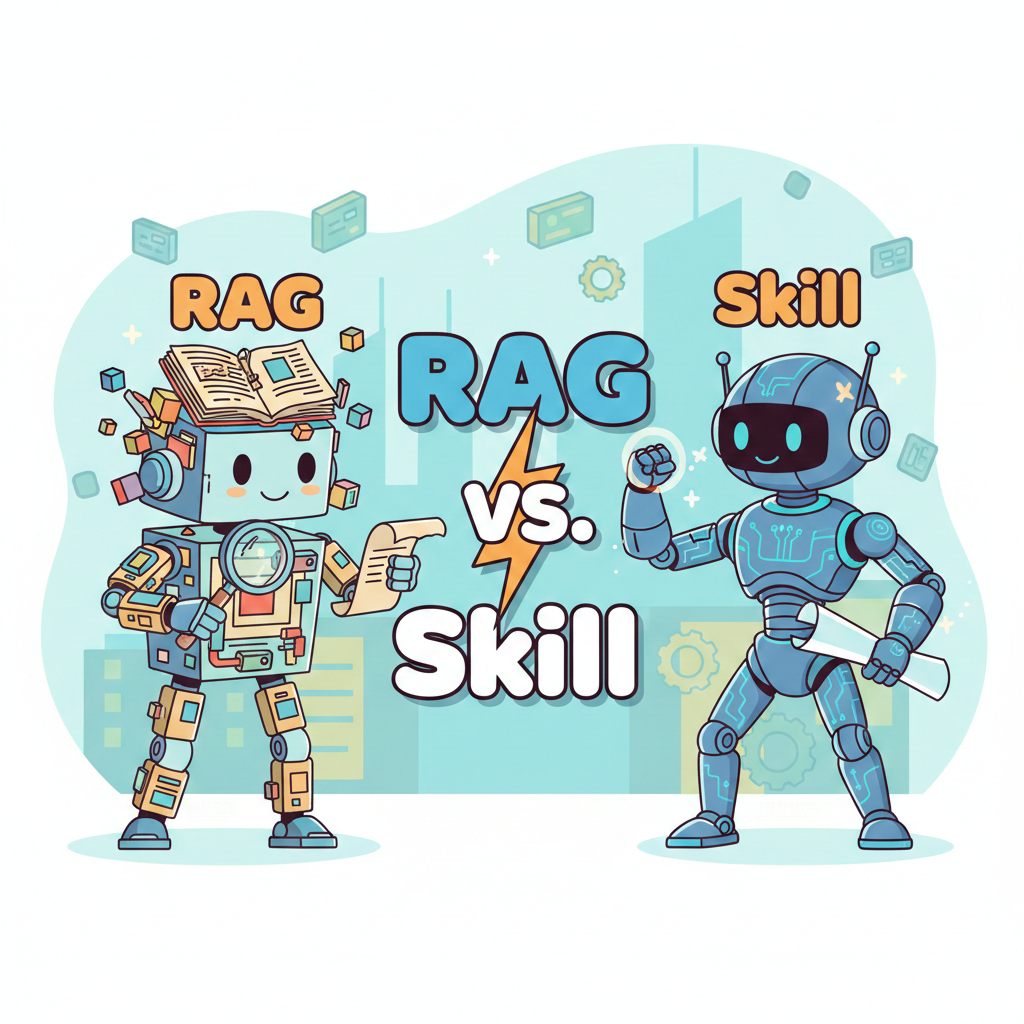
"So basically, agent skills are just another way to feed documents to the agent, right?"
This question comes up frequently in conversations about AI agents. And every time, it reveals a fundamental misunderstanding that limits how companies think about agent capabilities.
Agent skills and RAG are not the same thing. They solve different problems, operate at different levels, and conflating them leads to underestimating what skills can actually do for your AI strategy.
Let's clear this up.
What Is RAG? A Quick Definition
RAG — Retrieval-Augmented Generation — is a retrieval mechanism. Its job is to search through a corpus of documents and return relevant information to the agent.
When a user asks "What is our return policy for international orders?", RAG searches the policy documents, finds the relevant section, and serves that text to the agent. The agent then uses this retrieved content to formulate its response.
RAG is essentially a search engine for your internal knowledge base. It finds and returns existing content. Nothing more, nothing less.
This is valuable. Without RAG, an agent only knows what it learned during training — generic knowledge with no awareness of company-specific information. RAG bridges that gap by giving the agent access to proprietary documents.
But retrieval is where RAG stops. It answers the question: "What information exists about this topic?"
What Is an Agent Skill?
A skill is fundamentally different. It is not about retrieving information — it is about enabling competent execution.
A skill packages three elements together: the domain knowledge relevant to a specific task, the process logic for how to handle that task properly, and the execution capabilities to actually perform actions.
Consider the difference with a concrete example.
A user says: "I want to return this product I ordered three weeks ago."
With RAG alone, the agent can search the return policy document and tell the user what the policy says. It retrieves and relays information.
With a return handling skill, the agent understands the policy rules, knows the process steps for evaluating a return request, can check order history and eligibility, and can initiate the return in the system if conditions are met. It doesn't just inform — it executes.
A skill answers a different question: "How should this task be handled, and what actions are required?"
RAG vs Agent Skills: The Core Distinction
The confusion between RAG and skills often stems from surface-level similarity: both involve "giving information to the agent." But the nature of that information is entirely different.
RAG provides content — raw text retrieved from documents that the agent must interpret on its own.
Skills provide context — structured knowledge that shapes how the agent reasons, decides, and acts in specific situations.
| Aspect | RAG | Agent Skill |
|---|---|---|
| Purpose | Retrieve existing content from documents | Enable competent task execution |
| Output | Information returned to the agent | Action + outcome delivered to the user |
| Contains | Search mechanism + document corpus | Knowledge + process logic + execution capability |
| Analogy | Library access | Professional training |
| Answers | "What information exists?" | "How should this be done?" |
Think of it this way: RAG is like giving someone access to a library. Skills are like giving someone professional training. Access to medical textbooks does not make someone a doctor. The training — which combines knowledge, methodology, and practical capability — does.
An agent with RAG can look things up. An agent with skills can perform tasks competently.
Why This Matters for AI Agent Design
When companies treat skills as "just another way to feed documents," they design their agents around retrieval rather than capability. The result is an agent that can answer questions but struggles to actually help users accomplish tasks.
This shows up in several ways:
- Agents that provide accurate information but require users to take all the actions themselves
- Agents that lack consistent methodology for handling complex requests
- Agents that cannot adapt their behavior based on situational context
When to Use RAG vs Skills: A Practical Framework
Here is a simple way to determine which approach applies to a given need:
Use RAG when the goal is to surface existing information — answering questions about policies, finding relevant documentation, providing reference material.
Use skills when the goal is competent task execution — handling requests that require understanding context, applying rules, following processes, and taking actions.
Use both when an agent must operate as a capable assistant rather than a search interface. In most real-world applications, this is the case.
The Integration Question
A natural question arises: where do tool integrations fit in this model?
Traditional architectures often separate knowledge (RAG), reasoning (the LLM), and actions (tool integrations) into distinct layers. This creates complexity and fragmentation — the agent must coordinate between systems that don't inherently understand each other.
A more effective approach bundles these elements together. When domain knowledge, process logic, and execution capability are packaged as a unified skill, the agent gains a coherent competency rather than disconnected pieces.
This is the approach Skilder takes: skills are complete competencies, not just documents or tool connections. The agent doesn't retrieve a policy, then separately figure out how to apply it, then separately invoke a tool. It has an integrated capability for handling that type of task.
Key Takeaways
RAG is a retrieval mechanism. It searches documents and returns content. Valuable for information access, but limited to that function.
Skills are packaged competencies. They combine domain knowledge, process methodology, and execution capability into a unified ability to handle specific tasks.
They're complementary, not competing. Most production agents need both.
For teams building AI agents, the strategic question is not just "What information does the agent need?" but "What competencies does the agent need to do its job well?"
The answer to that question shapes whether you end up with a chatbot or a capable assistant.
Frequently Asked Questions
Is RAG the same as an agent skill?
No. RAG is a retrieval mechanism that searches documents and returns relevant text. An agent skill is a packaged competency that combines domain knowledge, process logic, and execution capability to enable task completion.
When should I use RAG vs a skill?
Use RAG when the goal is to surface existing information from documents. Use skills when the agent needs to perform tasks that require applying rules, following processes, and taking actions — not just returning information.
Can an AI agent have both RAG and skills?
Yes, and most production-grade agents need both. RAG provides access to company-specific information. Skills provide the capability to act on that information competently. Together, they create an agent that is both informed and capable.
Why do people confuse RAG and agent skills?
Both involve "giving information to the agent," which creates surface-level similarity. The key difference is that RAG provides raw content for the agent to interpret, while skills provide structured context that shapes how the agent reasons and acts.
Related Articles
Beyond Single .md Files: How Skill Graphs Scale AI Context
Graphs enable AI agents to navigate domain expertise through interconnected nodes rather than monolithic files. Learn how this changes context architecture.
Read more
Retrieval Is the New Intelligence
AI agents are getting smarter every day. But their biggest challenge isn't thinking. It's finding the right tool for the job.
Read more
Beyond "MCP vs Skills": Composing for Scalable Agent Architecture
The debate framing MCP and Skills as competitors misses the point. They solve different problems: MCP tackles the N×M integration problem, Skills address context saturation.
Read more