Beyond Single .md Files: How Skill Graphs Scale AI Context
From Instructions to Intelligence: Why Skill Graphs Are the Missing Layer in Enterprise AI
People underestimate the power of structured knowledge. It enables entirely new kinds of applications.
Right now people write skills that capture one aspect of something. A skill for summarizing, a skill for code review and so on. Often one file with one capability.
That's fine for simple tasks but real depth requires something else.
Imagine a mortgage advisory skill that provides relevant information about loan qualification criteria, regulatory compliance frameworks, risk assessment methodologies, property valuation standards, and customer communication best practices.
A single skill file can't hold that.
The Problem: Single Skills Hit a Complexity Ceiling
When you try to capture complex domain knowledge in a single file, you run into hard limits:
- Artificial boundaries - Related concepts get separated because they "belong" to different skills
- Knowledge duplication - Shared concepts get copied across multiple skills, creating maintenance nightmares
- Lost connections - The relationships between concepts aren't navigable, they're just implicit
- Scalability breakdown - Beyond 500-1000 lines, single files become unmanageable
The single-file approach forces you to choose between depth and navigability. Skill graphs eliminate that tradeoff.
Skill Graphs: The Next Evolution
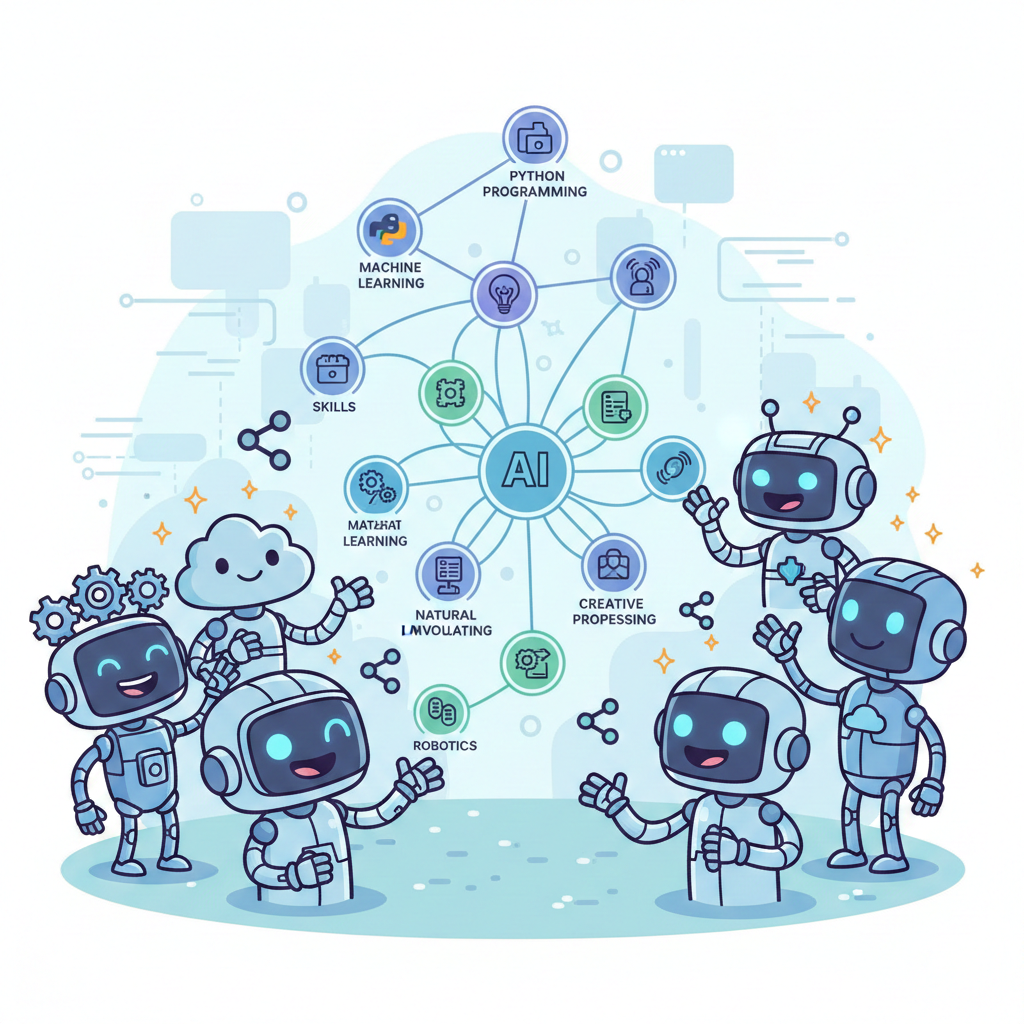
A skill graph is a network of interconnected skill files that reference each other.
Instead of one big file you have many small composable pieces that link together. Each file is one complete thought, technique, or business rule. The connections between them create a traversable graph that agents navigate intelligently.
A skill graph applies the same skill discovery pattern recursively inside the graph itself.
Every node has metadata the agent can scan without reading the whole file.
Every connection carries meaning because it's embedded in context, so the agent follows relevant paths and skips what doesn't matter.
Progressive disclosure:
- Index to descriptions to links to sections to full content
Most decisions happen before reading a single full file.
Single Skills vs. Skill Graphs: The Comparison
| Dimension | Single Skills | Skill Graphs |
|---|---|---|
| Depth | Limited to what fits in one file | Unlimited, scales with domain complexity |
| Maintainability | Update requires editing entire file | Update one node, entire graph benefits |
| Composability | Hard to reuse across contexts | Designed for composition and reuse |
| Context Flow | Isolated silos of knowledge | Interconnected expertise networks |
| Agent Behavior | Follows instructions | Understands domain relationships |
| Time to Value | Fast for simple tasks | Compounds over time as graph grows |
| Scalability | Breaks down beyond 500-1000 lines | Scales to thousands of interconnected nodes |
Skilder's Skills Infrastructure
Skilder is building the capabilities infrastructure for the AI workforce. The platform enables organizations to package domain expertise into skill graphs that AI agents can traverse and execute.
The platform isn't about storing files. It's about creating executable knowledge graphs where business logic becomes operational infrastructure.
Think about what this enables when you move beyond single files to interconnected expertise networks:
- A construction company skill graph: safety protocols, compliance requirements, vendor management, project scheduling, quality assurance checklists. Each piece linked to related procedures so context flows between them
- A financial services skill graph: mortgage products, underwriting criteria, regulatory compliance, customer qualification rules, risk frameworks. All traversable from one entry point
- A manufacturing company skill graph: quality standards, production workflows, supplier requirements, inventory policies, equipment maintenance. None of these fit in one file but all of them work as graphs
How It Works: Infrastructure Primitives
Skilder's skill graph architecture is built on three core elements:
- Semantic connections embedded in natural language context, so links carry meaning not just references
- Structured metadata with descriptions so agents can scan and decide without reading full files
- Topic maps that organize clusters of related skills into navigable domains
Implementation Architecture
The skill graph architecture Skilder implements follows this pattern:
1. Skill Generation
Documents and policies are processed to generate structured skill nodes without requiring ML expertise.
2. Combination Layer
Skills aggregate with tool integrations through Model Context Protocol (MCP), providing both context and action capabilities.
3. Role-Based Bundling
Skills are organized into domain-specific bundles (e.g., Mortgage Advisor, Safety Officer) that represent complete operational contexts.
4. Distributed Execution
The infrastructure distributes across organizations with full execution tracing and auditability.
These components work together as nodes in an interconnected graph rather than isolated capabilities.
What This Changes
Traditional approaches come with significant constraints:
- Custom RAG builds: $10K-$35K per model, 6-12 months,
- Generic chatbots: No business context, limited adoption for mission-critical work
- Fine-tuning: Requires scarce ML talent, expensive retraining for every update
Skill graphs offer a different approach:
- Domain expertise packaged as traversable infrastructure
- Agents can navigate business logic contextually
- Context compounds and evolves with usage
- Updates propagate through the graph without retraining
The difference is between an agent that follows instructions and one that can navigate domain relationships.
Emergence Through Usage
Skill graphs exhibit interesting emergent properties as they scale:
- Individual contributors create skills for their specific workflows
- Usage patterns reveal which conceptual connections are actually relevant
- Navigation traces show how agents traverse domain knowledge in practice
- Cross-organizational patterns can surface common approaches to similar problems
- Meta-patterns emerge from aggregated graph traversal data
Infrastructure Deployment Considerations
Skill graphs containing business logic raise important deployment questions. Skilder's implementation addresses these through:
- Data residency options including Swiss-hosted infrastructure
- Compliance by design for GDPR and similar frameworks
- Governed deployment capabilities for enterprise scale
- BYOK architecture to eliminate pass-through AI API costs
Looking Forward
Skills represent one approach to context engineering: curated knowledge injected where it's needed.
Skill graphs extend this by making that knowledge navigable rather than monolithic. Instead of single injections, agents traverse knowledge structures and pull in what the current context requires.
As enterprises continue working on AI adoption, questions around structuring and maintaining business context will likely become increasingly important.
References
Related Articles

Retrieval Is the New Intelligence
AI agents are getting smarter every day. But their biggest challenge isn't thinking. It's finding the right tool for the job.
Read more
Beyond "MCP vs Skills": Composing for Scalable Agent Architecture
The debate framing MCP and Skills as competitors misses the point. They solve different problems: MCP tackles the N×M integration problem, Skills address context saturation.
Read more